FAQ
Short answers to the questions visitors ask most.
Frequently asked questions
Which cave in Slovenia should I visit if I only have time for one?
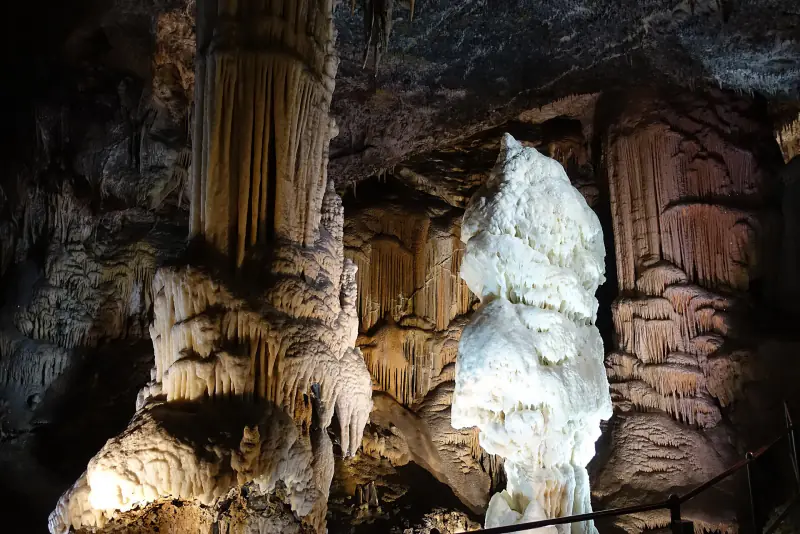
For most people the choice is between Postojna Cave and the Škocjan Caves. Postojna has the richer dripstone decoration, an underground train and an easy, mostly level route. Škocjan has a huge underground river canyon and a wilder feel, but several hundred steps.
Choose Postojna for comfort, children and formations; choose Škocjan for scale and drama. They are 35 minutes apart, so many visitors see both.
How cold is it inside the caves?
Between 8 and 12 °C all year in the lowland caves, with humidity near 100%. Postojna is about 10 °C, Škocjan about 12 °C and Križna jama about 8 °C. Snežna jama, an ice cave at 1,500 m, is around freezing near the entrance. Bring a warm layer even in summer.
Do I need to book tickets in advance?
In July and August, yes for Postojna and Škocjan; timed tours sell out. Outside high season you can usually buy tickets on arrival. The longer boat tours of Križna jama are strictly limited and should be reserved weeks or months ahead. Smaller caves open on limited days, so check their schedule.
How long does a visit take?
A standard tour of Postojna Cave lasts about 1.5 hours and the main tour of Škocjan about 2 hours. Smaller caves take 40 minutes to an hour. Allow extra time for parking, queues and, at Škocjan, the walk back from the doline.
Are Slovenia's caves suitable for children?
Yes. Postojna Cave, with its train and olm vivarium, suits all ages. Pekel Cave and Kostanjevica Cave are short and easy. Škocjan is better for children who can manage many steps and are comfortable with heights. Some adventure tours and the long tour of Križna jama have minimum ages.
Can I visit the caves without a guide?
No. All show caves in Slovenia are visited on guided tours at set times. Wild caves should only be entered with proper equipment and experienced companions, ideally through a caving club. See Caving safely.
How do I get to Postojna and Škocjan from Ljubljana without a car?
Trains and buses run from Ljubljana to Postojna in about an hour; the cave is roughly a 20-minute walk from the town centre. For Škocjan, take a train on the Ljubljana–Koper line to Divača and follow the signed footpath to the park's visitor centre, about 3 km. Organised day tours from Ljubljana cover both.
What is an olm and where can I see one?
The olm (Proteus anguinus) is a blind, pale cave salamander found only in the underground waters of the Dinaric karst. It can live for up to a century. The easiest place to see one is the vivarium at Postojna Cave. Read more on the olm page.
Is photography allowed?
Rules vary by cave and have changed over time. Where photography is permitted, flash and tripods are generally not, to protect wildlife and keep groups moving. Ask the guide at the start of the tour and follow the current rules of the operator.
Are the caves open in winter?
Postojna Cave, the Škocjan Caves and Predjama Castle are open all year, with fewer daily tours in winter. Most smaller caves close from late autumn to spring, in part to protect hibernating bats.
Why is the landscape called 'karst'?
The term comes from the Kras plateau in south-west Slovenia, known in German as Karst. Scientists studying limestone landscapes in the 19th century used it as their model, and the regional name became the international word. See The Classical Karst.
How many caves are there in Slovenia?
The national cave register lists more than 14,000, and cavers add over a hundred new ones each year. Around a dozen are equipped as show caves. The longest is the Migovec system (over 40 km) and the deepest is Čehi 2 on Mount Kanin (about 1,500 m).
Is this website connected with DeepSeek, the AI company?
No. Deep Seek Slovenia is an independent guide to caves and karst. It has no connection with any artificial intelligence company or product, or with any cave operator or tourist board.
Still planning?
The practical guide and ready-made itineraries cover the rest.