Glossary
Doline, polje, ponor, speleothem: the vocabulary of the underground, explained.
A to Z
The language of caves
32 terms, in plain English.
Karst science took much of its vocabulary from the languages of this region. This glossary explains the terms used on the site, together with a few Slovene words you will meet on maps and signs.
- Brezno Slovene
- A shaft or pothole: a cave that is predominantly vertical. Common in the names of deep alpine caves.
- Burja bora
- A cold, gusty north-easterly wind that sweeps the Karst plateau and the coast, mainly in winter.
- Collapse doline udornica
- A steep-sided, often very deep hollow formed when the roof of a cave chamber falls in. Velika dolina at Škocjan is an example.
- Column
- A dripstone pillar formed when a stalactite and a stalagmite meet.
- Curtain drapery
- A thin, wavy sheet of calcite hanging from an inclined ceiling, often translucent and banded.
- Doline vrtača
- A closed, bowl- or funnel-shaped depression in karst, typically tens of metres across. The word is of Slavic origin.
- Estavelle
- An opening that acts as a spring when groundwater is high and as a swallow hole when it is low. Found on the bed of Lake Cerknica.
- Flowstone sinter
- Sheets of calcite laid down by water flowing in a film over walls and floors.
- Flysch
- Layered sandstone and marl that does not dissolve. Rivers flow on it normally and sink where they meet limestone.
- Helictite
- A small, twisted speleothem that grows in any direction, apparently ignoring gravity.
- Jama Slovene
- Cave. Jame is the plural, as in Škocjanske jame.
- Karren škraplje
- Grooves, runnels and sharp ridges dissolved into bare limestone surfaces.
- Karst kras
- A landscape formed on soluble rock, with underground drainage, caves, dolines and few surface streams. Named after the Kras plateau.
- Natural bridge naravni most
- A remnant of a cave roof left spanning a valley after the rest has collapsed, as at Rakov Škocjan.
- Neoteny
- Reaching sexual maturity while retaining juvenile features. The olm keeps its larval gills for life.
- Phreatic
- Formed below the water table, in completely flooded conditions. Phreatic passages tend to be rounded tubes.
- Polje
- A large, flat-floored closed basin in karst, often flooded seasonally. Literally 'field'.
- Ponor
- A swallow hole: a point where surface water disappears underground.
- Rimstone dam gour
- A wall of calcite built up at the edge of a pool by the water flowing over it. The lakes of Križna jama lie behind such dams.
- Show cave
- A cave equipped and managed for visitors, usually with paths, lighting and guided tours.
- Soda straw
- A thin, hollow stalactite with the diameter of a water drop; the first stage of most stalactites.
- Speleology
- The scientific study of caves. A speleologist studies them; a caver explores them; many people do both.
- Speleothem
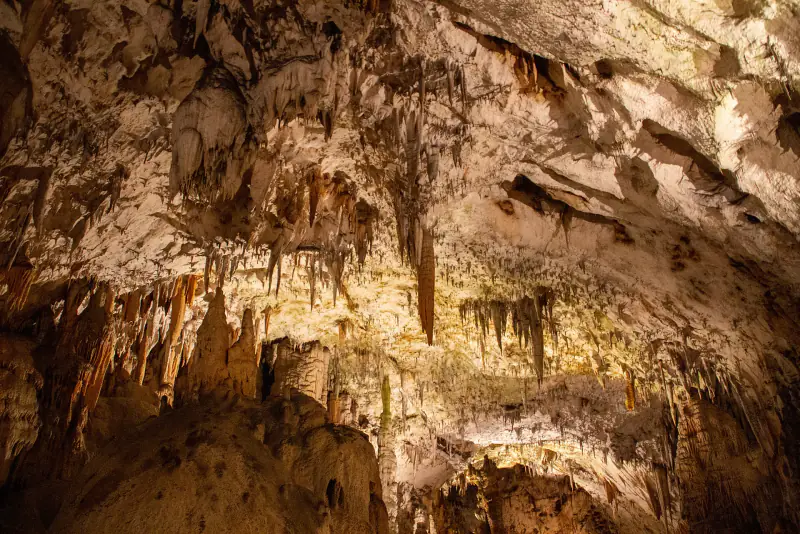
- Any mineral deposit formed in a cave: stalactites, stalagmites, flowstone and the rest. Commonly called dripstone.
- Stalactite
- A speleothem hanging from the ceiling. Memory aid: c for ceiling.
- Stalagmite
- A speleothem rising from the floor. Memory aid: g for ground.
- Stygobite
- An animal that lives only in groundwater. The olm is the best-known example.
- Sump siphon
- A section of passage completely filled with water, passable only by diving.
- Terra rossa
- Red, clay-rich soil left behind when limestone dissolves; characteristic of the Karst.
- Troglobite
- An animal that can live only in caves, typically blind and without pigment.
- Uvala
- A larger closed depression formed by the merging of several dolines.
- Vadose
- Formed above the water table, by free-flowing streams. Vadose passages are often tall, narrow canyons.
- Vauclusian spring
- A spring fed by water rising under pressure through a deep flooded shaft. Wild Lake near Idrija is one.
See the terms in context
The page on how caves form puts most of these words to work.