How caves form
Slightly acidic water, soluble rock and time. The recipe is simple; the results fill a country.
Rain, soil and stone
A cave is the plumbing of a landscape, made visible.
Limestone is made largely of calcium carbonate, which pure water hardly dissolves. Rainwater, however, picks up carbon dioxide from the air and far more from the soil, where roots and microbes produce it. The result is a weak carbonic acid that dissolves limestone slowly but steadily.
Water finds its way down along cracks and the bedding planes between rock layers. The routes that carry the most water widen fastest and capture still more flow. Over tens or hundreds of thousands of years a network of fissures becomes a network of passages.
Below the water table, passages are completely flooded and are dissolved on all sides into rounded tubes. Above it, streams run with a free surface and cut downwards like any river, leaving tall canyon passages. Many caves show both: a tube in the ceiling with a trench cut in its floor, the record of a falling water table.
From crack to chamber
Water goes underground
Streams flowing off impermeable rock reach limestone and sink at ponors. Rain soaks in through thousands of small fissures.
Passages enlarge
Acidic water widens the most favourable routes. Flooded tubes form below the water table, canyons above it.
The water moves down
As valleys deepen, the water table falls. Upper passages are left dry, and the river makes a new, lower level.
Dripstone grows
Seepage water entering air-filled passages loses carbon dioxide and deposits calcite as stalactites, stalagmites and flowstone.
Roofs collapse
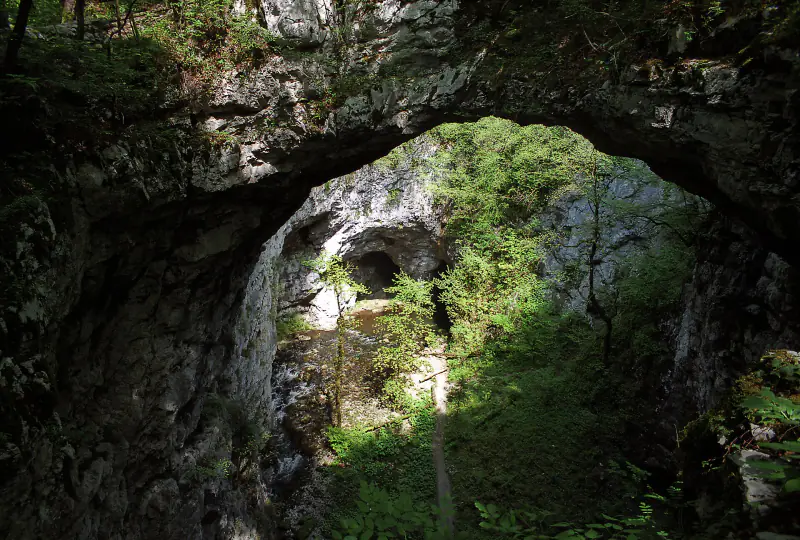
Unsupported ceilings fall. Underground this produces great halls; near the surface it opens collapse dolines and natural bridges.
The cave is unroofed
Eventually the surface is lowered until it cuts into the cave, leaving only a line of hollows and scattered dripstone in the soil.
How dripstone grows
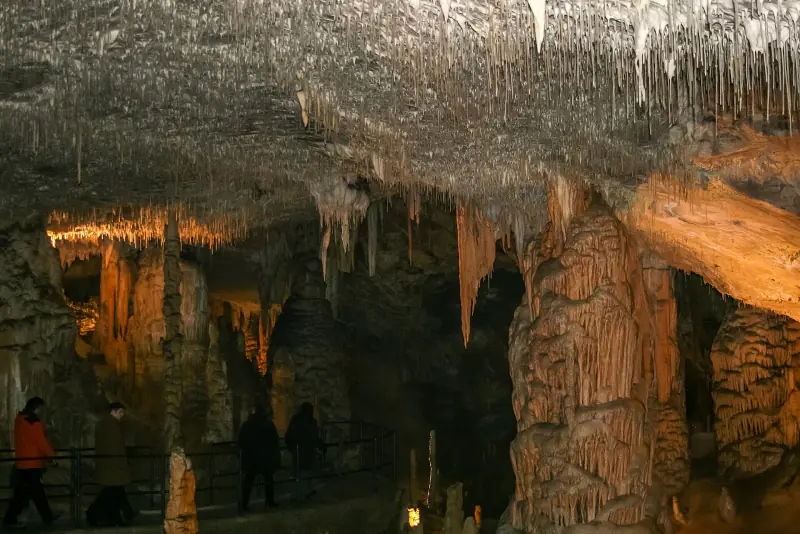
The process that makes caves also decorates them, running in reverse. Water seeping through the rock above is rich in dissolved calcium carbonate and carbon dioxide. When a drop enters a ventilated passage, the gas escapes and a trace of calcite is left behind.
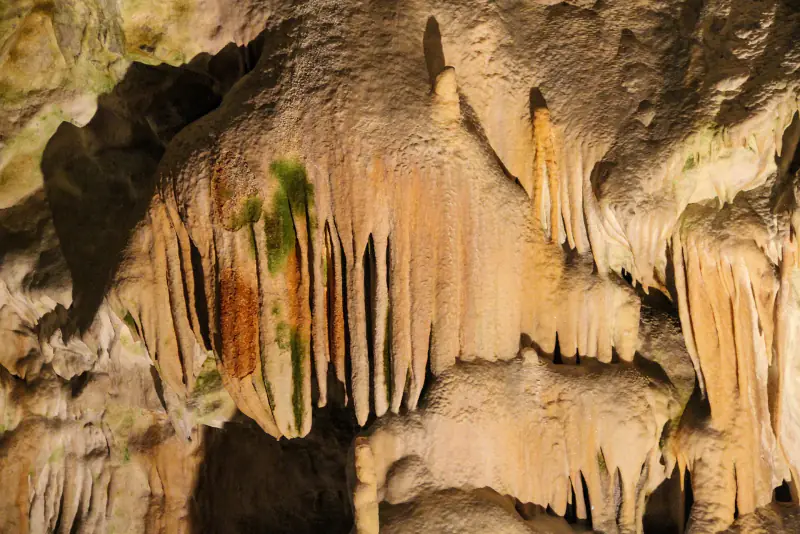
On the ceiling this builds a hollow tube, a soda straw, which thickens into a stalactite when the central canal blocks. Where the drop lands, a stalagmite rises. In time the two may join as a column. Water flowing in a film lays down sheets of flowstone; along a sloping ceiling it builds translucent curtains.
Growth is slow: commonly a few hundredths to a few tenths of a millimetre a year. A stalagmite as tall as a person may have taken tens of thousands of years. This is why touching formations is forbidden. Skin oils stop calcite from adhering and leave a permanent dark stain.
Dams built by the water itself
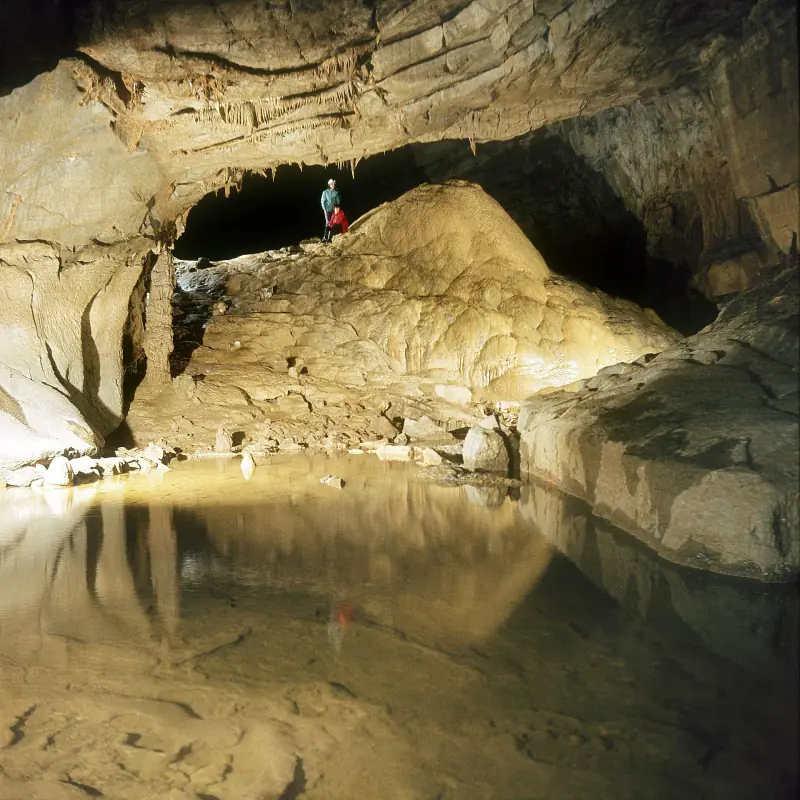
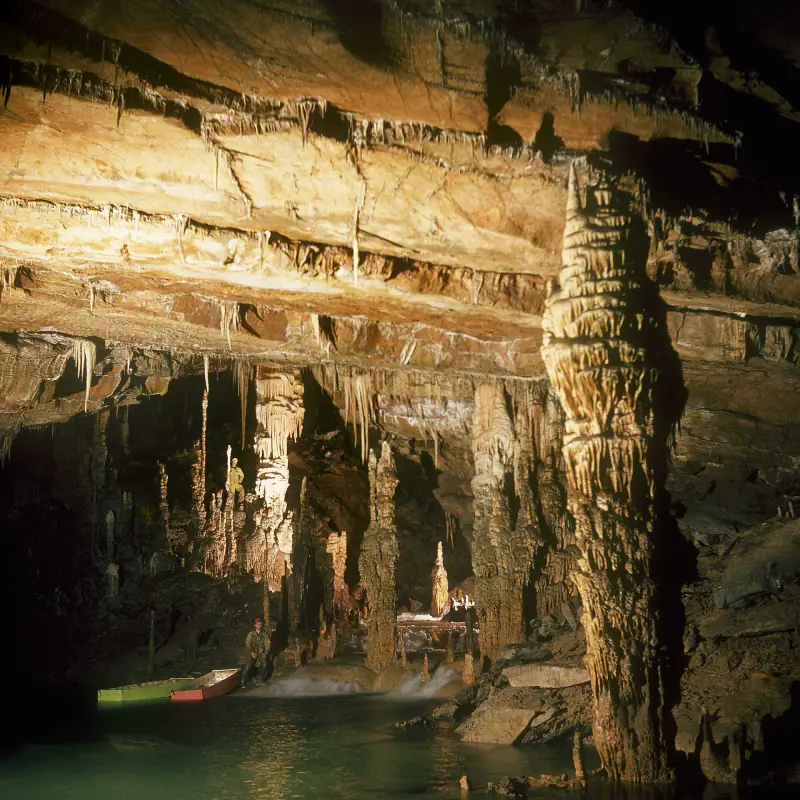
Where calcite-rich water flows over an irregular floor, deposition is fastest at the lip of each small step, where the water is thinnest and most turbulent. The lip grows into a wall, and a pool forms behind it.
These rimstone dams, or gours, range from a few millimetres to several metres high. The lakes of Križna jama are held back by them, as are the terraces called Ponvice in the Škocjan Caves.
Dolines, poljes and ponors
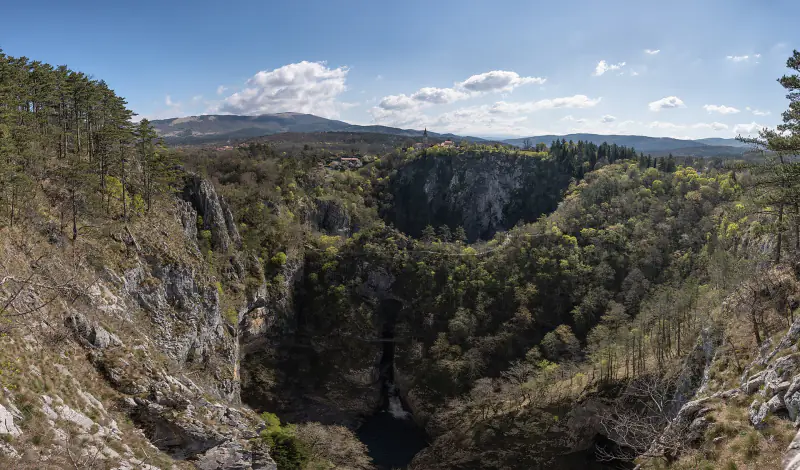
A doline is a closed, bowl-shaped hollow, usually tens of metres across, formed where the rock dissolves fastest around a drainage point. On the Karst plateau farmers cleared stones into their floors to make the only deep soil available.
A collapse doline is different: steep-walled and often very deep, it marks a place where a cave roof has fallen in. The pair at Škocjan are the classic example.
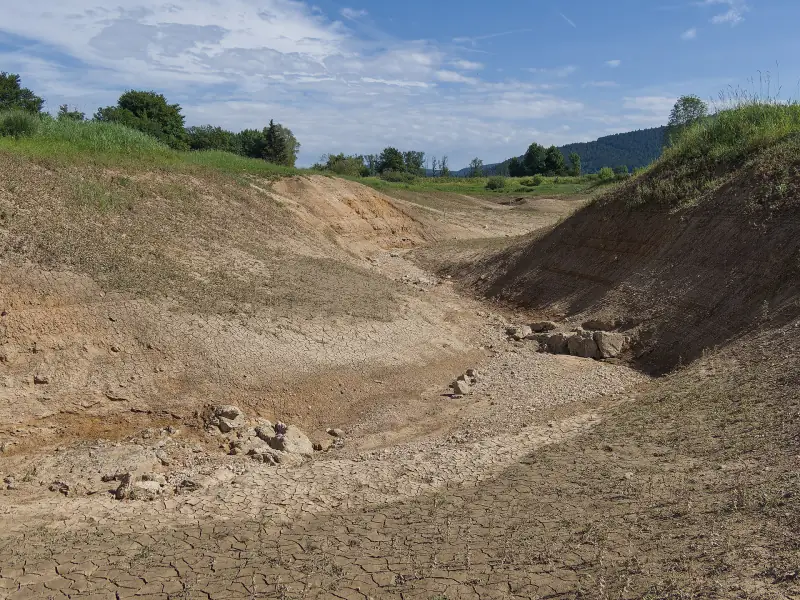
A polje is a large, flat-floored basin with no surface outlet. Water enters from springs on one side and leaves through ponors, swallow holes, on the other. When the ponors cannot cope, the polje floods.
What the rock is telling you
The same temperature, all year
Rock is a good insulator. A few tens of metres from the entrance the air in a cave settles at roughly the average annual temperature of the surface above it. In lowland Slovenia that means 8 to 12 °C in January and in July. High alpine caves are colder, and where cold air can sink in and become trapped, as in Snežna jama, ice survives the summer.
Humidity is close to 100 per cent. This stable climate is what allows fragile mineral formations to grow undisturbed and specialised animals to live without seasons.